 | Wall of ash envelops Indonesia volcano Ash spewing from Indonesia's Mount Sinabung formed a massive cloud around the mountain on Tuesday. The volcano in the province of North Sumatra has been erupting sporadically for several months, damaging crops and triggering the evacuation of more th… |
Showing posts with label environment. Show all posts
Showing posts with label environment. Show all posts
Tuesday, January 07, 2014
This is not the cinnabon that I was looking for.

Thursday, November 21, 2013
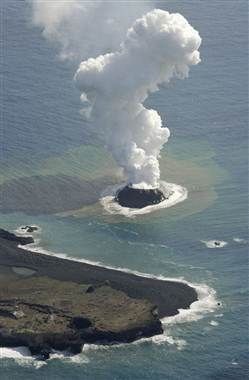
Those imperialist Japanese just took over another island!

 |
| Kyodo News via AP |
Oh, wait, no they didn't. A new caldera formed near the Bonin Islands.
"This has happened before and in some cases the islands disappeared," Yoshihide Suga said when asked if the government was planning on naming the new island. "If it becomes a full-fledged island, we would be happy to have more territory."Heh.
Thursday, February 21, 2013
Okay, didn't need to see that...
While dissecting alligators to see how they mate, Diane Kelly, an anatomist at the University of Massachusetts, found an always erect penis:
To see how it popped in and out of the alligator's body, she tugged on various tendons and muscles in the cloaca region and found one set of muscles that caused the penis to shoot out. Another set of tendons attaches to the base of the penis like rubber bands, she said.
"As soon as those muscles relax, the penis gets whipped back into its original position."Go to the link see video of this... operation.
Thursday, October 04, 2012
I See a Disturbing Lack of Net Power Calculation
In this story about an interesting idea of making wind energy portable or able to be stored in some fashion, the omission of net power with current turbine engineering belies its conceptual usefulness. The idea of using wind energy to liquify nitrogen, then let it expand again to fill in turbine downtime is novel, but the net power consumption does not even come close to rivaling battery technology right now. Either the turbines need to produce much more power, or the liquification process needs to become much more efficient. Still, lots more basic engineering research needs to be done even to determine if this is a viable solution. Thermodynamics is not a very forgiving branch of physics.
Monday, June 14, 2010
The Ravens: An Image of Mortality
Recently, dear online friends have passed away suddenly, one last week, and one just last night. So, death and mortality has been on mind lately. I was reminded this morning, upon hearing the news of my friend's passing, of the scene I came upon this past Saturday while climbing the roads near the reservoirs in Angeles National Forest.
On the right side of the road, huddled against a stone retaining wall, was a large dead or dying common raven. It did not appear to be moving, and I thought it must have been hit by a vehicle while attending to some roadkill. As I slowly approached it (I was going up a steep climb), another raven swooped in from my left, carrying some food in its mouth, and cawing loudly and protectively. I recalled that common ravens mate for life, and the loud one must have been the injured raven's mate. As the raven shooed me away, I grimly thought of the futility of trying to feed the prone raven, as at least one of its wings looked badly crushed, and as I mentioned before, it already looked dead to me.
I'm not one to anthropomorphize, since I know most of the animal behavior we see is instinctive, not rationally decisive, and should not lend itself to a romantic view of Nature. Still, Man has Animal nature, which fully informs and influences our behavior and relationships, so I could not deny a sympathetic pang at seeing a desperate raven trying to coax to life or health its last, one true mate. So, my sympathies are echoed louder as I think of and pray for the spouses and families of my departed friends. I will miss them, and I pray their families have strength in the coming days.
Thursday, February 26, 2009
Pikachu is Real!
If you've ever wondered if the electrified hamster known as Pikachu from the Pokemon animated universe was based on something real, now you have your answer.
 AP |  |
Allegedly, the pika's numbers aren't so hot in the Pacific Northwest, so, of course, some conservationist group wants to put them on the endangered species list. The reason: nebulous bugaboo global warming. Can we go back to the days when evil loggers caused all these cute, furry animals to leave their oh-so stable ecosystems and become so stressed out they couldn't make babies anymore? Here, the claim is that the poor pika's fur is so thick, it can't survive if temperatures hit above 80 degrees. Just how long in the future is this alleged endangerment supposed to be? Cuz, last I checked, the Pacific Northwest had more snow than they could handle this last winter, and even global warming predictions don't have North America approaching an 80 degrees average until 1000 years from now. Go figure on that one...
Well, maybe the little pika can adapt by electrifying itself so it can power some air conditioning for its rocky nests.
Friday, June 06, 2008
Finds From The Grind IV
Well, this is going to be a rambling post. I'm just warning you all right now. This morning for my ride, I decided to do two climbs in Sierra Madre, just 'cuz I'm crazy like that. The first climb was up to the dam on Woodland Drive. Once I got past Mary's Market and Cafe, I noticed the road became very dusty. I hoped I wasn't riding into a whole bunch of construction. But then I remembered that it had rained pretty hard for three days while I was in Chicago (no rain in Chicago, go figure), and I had already seen the rockslide damage on my other rides this week. And adding to the runoff was the fact that the scorched earth from the recent fire wasn't going to be soaking up any of that water either. So, I just hoped I wasn't slipping and sliding on my way down.

Flood control: basically a huge gutter...
As you can make out in the picture above, the fire damage pretty much meets right up with the dam, and there are houses packed into the little canyon. This really is how close that fire got to all those Sierra Madre homes. As I made my way across Sierra Madre to the next climb, I noticed some deer statues on someone's front lawn. My next thought was how big those three statues were of a buck, a doe, and a juvenile. As I got closer, I thought, "whoa, those are really big statues." And as I came up to the deer ensemble, the buck statue, while chewing on something, turned to inspect me. Gah! Those were real mule deer! The burn had made the local wildlife forage a little more down the mountain side. As I passed by the deer family, I remarked to the buck, "That's a whole lotta deer!" He just looked at me and continued to chew on whatever he had found in that front yard. I expect that resident's trees aren't going to be finding any bark left on his trees. Mind you, seeing that "statue" move was not as shocking as passing a skunk at 4:30 in the morning, and having it hiss at you. I didn't know skunks could make that sound. *shudder*
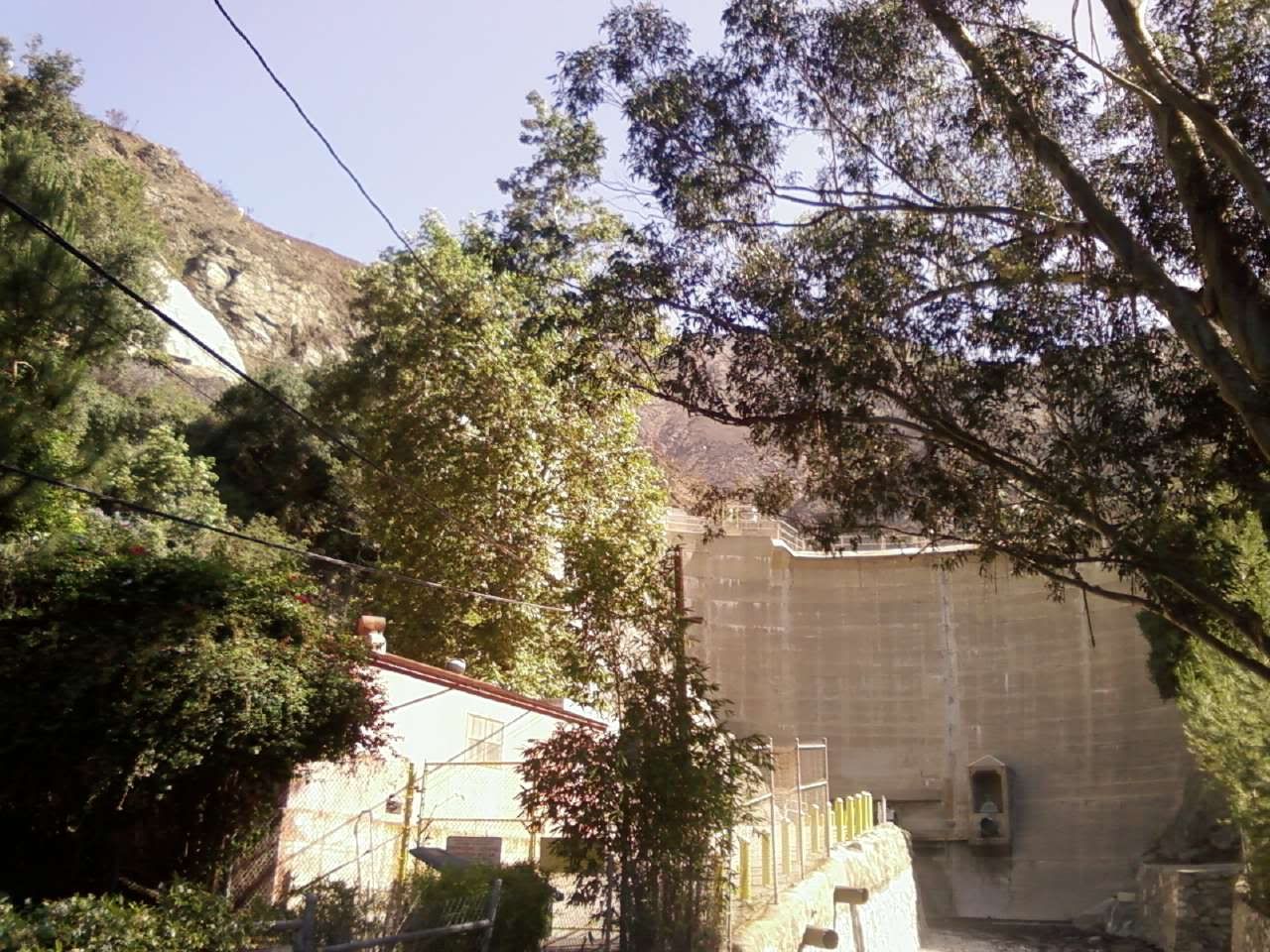
Flood control: basically a huge gutter...
As you can make out in the picture above, the fire damage pretty much meets right up with the dam, and there are houses packed into the little canyon. This really is how close that fire got to all those Sierra Madre homes. As I made my way across Sierra Madre to the next climb, I noticed some deer statues on someone's front lawn. My next thought was how big those three statues were of a buck, a doe, and a juvenile. As I got closer, I thought, "whoa, those are really big statues." And as I came up to the deer ensemble, the buck statue, while chewing on something, turned to inspect me. Gah! Those were real mule deer! The burn had made the local wildlife forage a little more down the mountain side. As I passed by the deer family, I remarked to the buck, "That's a whole lotta deer!" He just looked at me and continued to chew on whatever he had found in that front yard. I expect that resident's trees aren't going to be finding any bark left on his trees. Mind you, seeing that "statue" move was not as shocking as passing a skunk at 4:30 in the morning, and having it hiss at you. I didn't know skunks could make that sound. *shudder*
Monday, November 19, 2007
Quick Reaction to IPCC's SPM
The Nobel Peace Prize winning Intergovernmental Panel on Climate Change released its Statement for Policy Makers, based on their 4th Assessment Report, late Friday night, making sure the news cycle wouldn't notice some of the items that seem contradictory to the AGW activism narrative.
First, we've injected so much carbon dioxide into the atmosphere, that even if we stop all industrial and commercial sources right now, as in zero emissions, the earth will keep warming. Second, with this current warming trend, the sea level will rise up to a maximum of 55 inches over the next thousand years. Not one hundred years, but one thousand years. This is assuming we will follow their estimate for increasing carbon dioxide emissions over the next 50 years. Third, they recommend emphasis on the mitigation plans for their predicted climate change: building sea walls, developing drought-resistant crops, and paving dirt roads in all the poorest nations.
Can we now stop with all the carbon-offset scams and carbon-credit trading? But those two schemes were a way for the poor nations to trade their unused carbon-banks (since they have no developed industries anyway), to con the rich countries out of their money to pay, supposedly, for the mitigation projects. Nevermind that those sea-wall projects were usually tied to huge seaside resort proposals. Plus, the anti-GM crop crowd won't like the IPCC's change in tactics either. And paving dirt roads will encourage vehicle use and spur industrial growth, not just keep roads from being washed away in the predicted super-floods, so the emergency response organizations can reach flattened villages. So, will we stop hearing about reducing carbon emissions? I won't be holding my carbon dioxide producing breath.
Tuesday, November 13, 2007
Carbon Dioxide Removal Outpaced By Emissions
A new report that tries to place a real number on CO2 cycle in North America, estimates that carbon sinks, such as forests, and other sources (though what those others are, the AP neglects to add), only absorb about a third of total emissions. Of course, that's a downer, but more bad news needs to be added to that: the new forests from regrowth suck in carbon dioxide faster than old growth, so even the current absorption rate will decline. You know what that means? We're not doing enough of logging! We gotta cut down those big trees and plant little ones to... SAVE THE PLANET! No, no, what am I saying? Obviously we have to reduce our economic output by two-thirds and trigger global poverty. Geez, what was I thinking?
Thursday, November 08, 2007
Yellowstone Is Going To Blow!
A lot of the environmental movement's lunacy comes from the motivation for preservation. The Earth is pretty, and we must keep things exactly as they are! If some landscape is changing, and the Earth becomes unpretty, either we're at fault, or we need to do something, anything, to stop it! Well, the Earth has always been changing, and it's the same arrogance we have to manipulate the environment to make huge cities, that makes us want to manipulate the environment to change it back. Otherwise, why would we ever seriously consider endeavors which bury carbon dioxide under the sea, or spur huge algae blooms with pipes or iron dumping to gobble up that weak greenhouse gas.
It's also this arrogance that fueled the huge fires in Yellowstone in 1988. Bad fire management policies left way too much fuel to burn, instead of letting natural fires from lightning strikes run their course. Now, we have evidence that the ancient supervolcano underneath Yellowstone, which is the geothermal source of all the pretty geysers, is moving the crust upward at about three inches a year. There's no danger of eruption, yet, but when people are going crazy about the sea level going up three inches in a century, I can only wonder what the response would be. Of course, we aren't responsible for the environmental change, but what do you think will happen if the land rise continues, and alters all the pretty landscape? Will there be all this nonsensical talk of diverting the magma with huge pipes? The environmentalists' history of histrionics don't rule it out.
And will there be any histrionics about another land rise? The glacier on Mont Blanc, which has featured prominently as one of the disappearing glaciers due to evil man and his bad breath, has been growing since 2003, and climate weirdos are trying to pin the growth on global warming. The claim is that the icepack is growing because of the higher temperatures causing more winds to keep the icepack in place. So is this good news, bad news, or just head scratching? As a scientifically inquisitive kind of a guy, I always vote for head scratching, because that means new science, which means weak theories get shoved off those glacier growing peaks. Perhaps global models do poor jobs at reconstructing local climate changes, not due to lack of specific variables, but because local climate feedbacks are actually forcings, not the other way around.
Thursday, November 01, 2007
Who Pays For The Carbon Offsets?
The AP reports that the California wildfires spewed as much carbon dioxide in a week as all of California's power stations and vehicles during the same timeframe. There's a couple of things I want to point out in this story besides the proper doubt the story brings up. Who pays for the carbon credits in an arson fire? And which agency's numbers do you accept?
I've always felt that man's contribution to greenhouse gases is dwarfed by all the natural sources, and last week's fires definitely highlight that fact. The AP writer also points to the doubted efficacy of carbon offsets and trading when natural disasters strike:
It [a new study] raises questions about how useful it is to plant trees to offset rising carbon dioxide emissions and soothe environmental consciences.
California basically doubled it's carbon dioxide output for one week. How about another scenario? There are all these Pacific islands clamoring for future damages payments set aside by the Kyoto Protocol because predicted rising sea levels might destroy them. These payments are predicated on a member nation's carbon output. What if one of these islands' volcano erupts, gushing forth more carbon than the entire country of Australia in a decade? Are they held responsible for setting back the carbon trading scheme? Likewise for our arson fires, do the convicted arsonists also have to pay reparations to California, or the United States if we ever do join a carbon market, so that they can purchase credits to offset the extra damage?
Right now, there is no mechanism for these kinds of scenarios, because the Kyoto Protocol really doesn't care about reducing overall carbon levels to stop theoretical global warming. If it were, we would know exactly how much carbon dioxide is in the atmosphere, and how much of it industry actually put in there. But we don't, which brings me to the second thing I want to point out in the article.
Even the carbon dioxide levels we think are being injected into the atmosphere, be it natural or man-made, are theories also. The AP story is basically about a Colorado team about to publish a theoretical paper, and they just decided to apply their new computer program to the wildfires to calculate carbon output. They come up with 8.7 million tons. California's governmental body comes up with 6 million tons. What's the real number? Nobody knows, because those numbers are spit out by computer simulations, whose assumptions about fuel, burn rates, and chemical byproducts, are all theoretical. It's a wildfire model. So when the time comes to offset the carbon contribution of the volcano or wildfire, whose numbers do you go with?
This is why coming up with policy based on models that haven't been proven yet is sheer stupidity. It's taken twenty years to design the proper instruments and satellites to test the greenhouse theory, but they still won't be launched for another five years. When it will take 1000 years for sea levels to rise 23 feet, if the predictions are correct, I think we can wait until the data come in to support the theoretical model outputs. Honestly, what's the hurry? Unless the activists' plan is to get their policies in place before they are proven wrong, so that when the cooling cycle begins again, they can say their world-saving plans are working. But that's pretty cynical. Only someone who doesn't really care about the environment, but is more concerned with the prosperity gap between developed nations and poor nations, and wants to eliminate that gap by slowing working economies down, would come up with motivation like that. But you'd have to buy into economy stopping disaster scenarios like the population bomb, or peak oil. I mean, come on, those wacky ideas are over 40 years old. Nobody still believes them, do they?
Thursday, October 25, 2007
"Just Wants to Complain"
If you ever want to see the difference in how a Republican governor handles a major disaster compared to a Democrat, look at the response from Mississippi and Florida to hurricanes Katrina and Rita. And if you want to see how a Republican handles "nonsense" about lack of resources, just watch our Governator in action.
"Trust me when I tell you, you're looking for a mistake, and you won't find it, because it's all good news. As much as you maybe hate it, but it's good news. Trust me, okay?"
Of course, the fire danger is not over yet, especially for those places still burning. The good news is that containment numbers are no longer going to be "0 %" since the winds have died down. However, look for the media to descend like vultures on anyone complaining about how slow their FEMA check is coming, or evil insurance companies not honoring policies. Anything that might be "bad news."
Tuesday, October 23, 2007
Panda Smash
I really don't know why people in China think pandas are cute, fuzzy, roly-poly furballs. Teachers and parents should hang this story in classrooms and bedrooms of children everywhere: if you jump into a panda cage, expect your legs to get gnawed to the bone. Seriously, Japanese kids know what's up, thanks to their delightfully educational cartoons.
Wildfire Maps
Your tax dollars put to good use at the Forest Service.
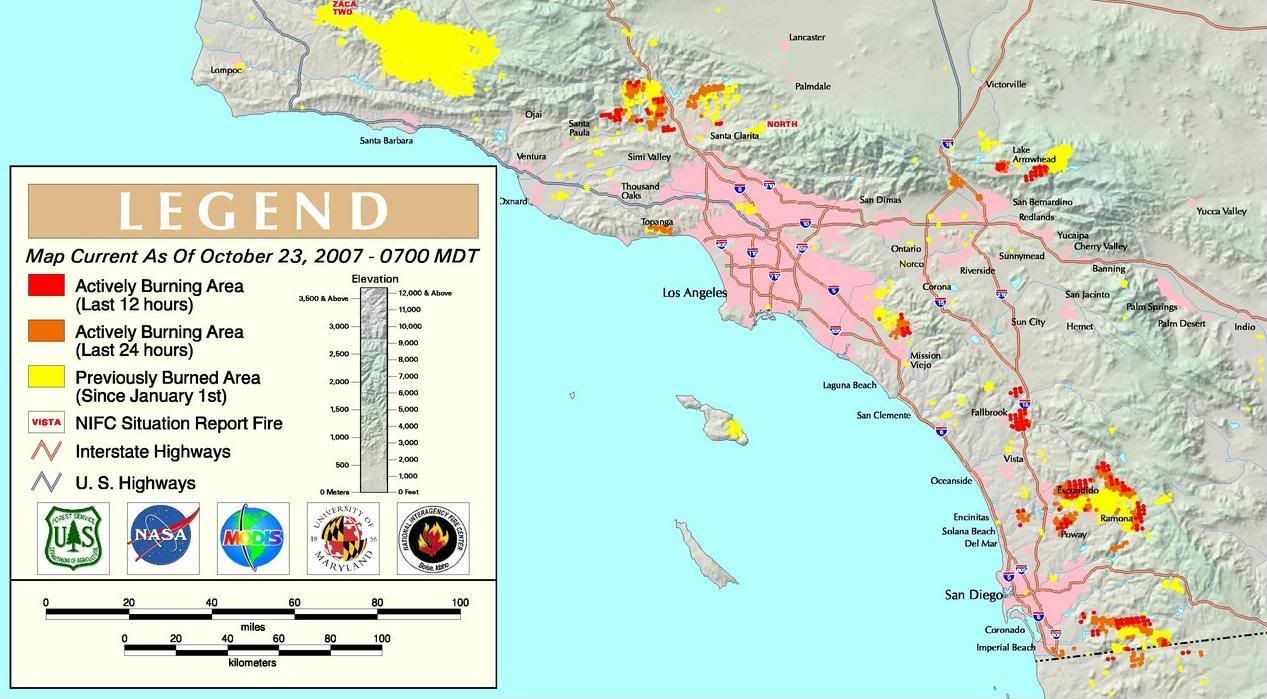
The image above is a cropped version of the active fire map of California from the link above.
Monday, October 22, 2007
Preoccupied
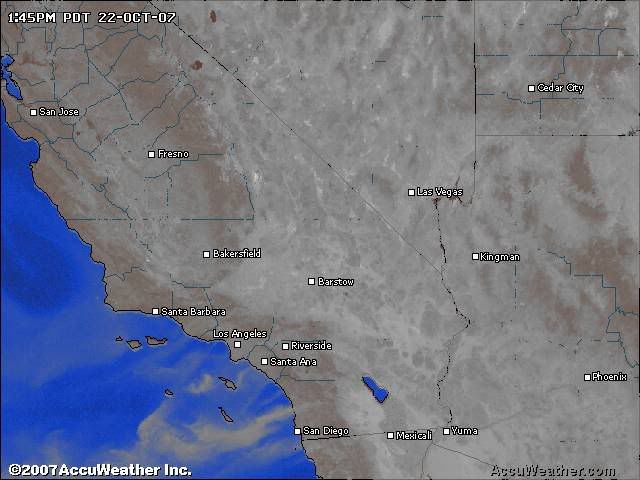
I'm a little preoccupied by firestorm affecting Southern California, being spread by the Santa Ana wind conditions. Already, there are mass evacuations in San Diego County, and the smoke clouds are large enough to be seen by satellite imagery.
Monday, October 15, 2007
Metal Theft Tied To Asia
The New York Times has finally noticed the massive increase in metal theft around the world, which has usually been linked to the high market prices for industrial metals, so they asked an economist about it. Ted Siegler, a recyclables analyst, said that it's not just metal prices that have gone up, but recycled material in general, which comes from a huge demand from Asian developing countries.
Bundled paper or cardboard, the most commonly stolen of New York’s recyclables, can bring in $90 to $120 a ton, more than double what the city receives under long-term contracts with its own brokers and processors.
That means someone can quickly fill a van in Manhattan, drive to Brooklyn, Queens or the Bronx, and sell the loot to one of several brokers. After that, most of the paper and metal ends up in China, Vietnam, India and other developing nations where demand for recyclables has soared.
“There has always been a fair amount of scavenging in the U.S., but the increase in demand from abroad has been dramatic,” said Ted Siegler, an economist and consultant based in Vermont who has analyzed recycling around the world.
He said a piece of scrap metal taken from a Manhattan curb might end up in a steel mill furnace in Asia.
Mr. Siegler said the theft of recyclables had been increasing across the country, with thieves even plucking steel manhole covers from streets.
According to the article, even cardboard is fetching twice the price from overseas than what a large city like New York City pays out for its recycling program. As with most municipalities across the nation, New York is going after the recyclers and brokers, treating them as fences who receive stolen goods. But even with the crackdown on theft, the metal and cardboard has to come from somewhere to keep with Asian development. There has to be a way a smart company, or even smart trade policy, can take advantage of that, without resorting to "plucking manhole covers from the streets."
Monday, October 08, 2007
Monday, August 27, 2007
Unintended Recyclable Consequences
Broward County in Florida is studying the idea of using recycled glass to mix in with sand to stop erosion. Trucking in sand is an expensive endeavor, and so far, the county officials have spent about 600,000 dollars studying whether the crushed glass idea is even feasible, and cheaper, than continuing with just plain old sand. One thing they know for sure, is that the glass bits do not erode at the same pace as the plain natural silica, which breaks down at a much faster rate. However, they don't know about the ocean's erosion patterns, whether dumping the crushed glass in one spot will actually stay there for a while. It would be a pretty expensive mistake to have the glass taken away by the ocean faster than regular sand. I am glad that the story mentions Florida's best cautionary tale for reuse: building artificial reefs of old tires, only to have the ocean currents blast them apart, and cost the state even more in cleaning up the environmental hazard.
Friday, August 10, 2007
Big Bugs Need To Breathe
After my bike buddy and I noted the striking similarity between our praying bike rack supervisor and the big bug from Men in Black, I was happy to find this post from Science Blog. It has long been theorized that the age of the giant bugs in our fossil record correlated quite nicely with the sediment record for oxygen concentration in our atmosphere. The more oxygen there is, the bigger the bug can get. After an ecological upheaval, the oxygen levels went down, and now we have regular sized land based arthropods. So can we really test that oxygen levels were the basis for big bugs? Using x-ray techniques to examine the tracheal passages of several species, we see pretty good evidence that oxygen is the key. Huge beetles have more airways in their bodies than smaller insects, especially in their legs. Using calculations to see how big a predicted beetle could get, testing whether airways were more important if they were connected to the head, or if the limbs were better, the team at Argonne National Laboratory found their predictions for maximum beetle size matched fairly well with the largest known species. So, now we know, the big bug wearing the Edgar suit has a lot of tracheal tubes in his legs, and probably evolved on a high oxygen atmosphere planet. I'd still say my prayers if I ran into it though.
Just Going For A Short Ride
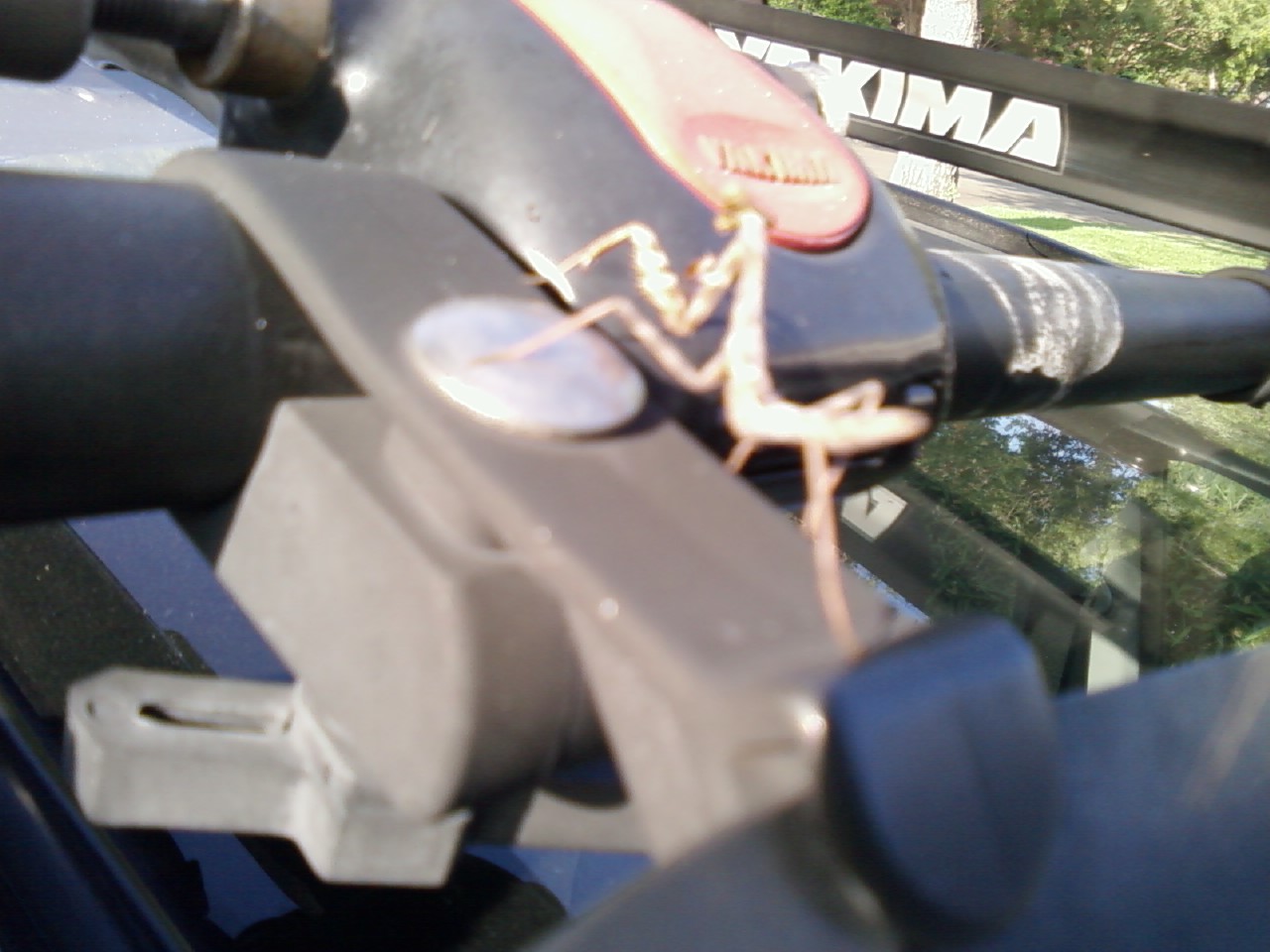
No need for prayers, little out of focus mantis. I don't crash that often. Seriously, this little guy was very curious about how to put a bike on a car rack. Even made sure it was safe for a little while, before flying off.
Subscribe to:
Posts (Atom)