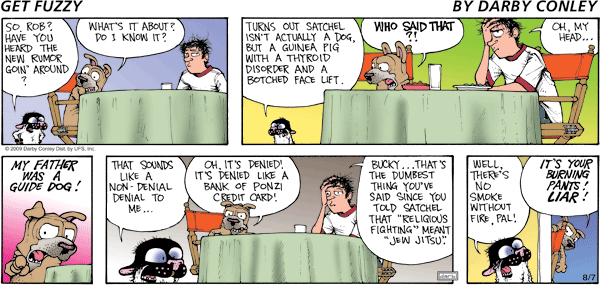
Yes, fools, brave, tough, hard, brash fools all.
I've never seen the Tour of Flanders live. I've seen it prepackaged long after I've read the headlines of the winner have flashed across the various cycling news sites I like. I've followed the the live chats from these sites, furiously hitting renew, refresh, reload buttons to be disappointed that those darn reporters have not typed out those hard to spell names in the 20 seconds I patiently afforded them to give me an update on whether some guy got dropped by some other guy coming out of the flat corners in the last 20 kms as they put their heads down against the winds. But this Sunday...
Writing on Anime and Cycling. Home of Omake Gif Anime, Omake ScreenCap, and 10 Second Anime.
Saturday, March 31, 2012
Thursday, December 01, 2011
Monday, October 10, 2011
Nobel Prize Winning Economic Advice
Christopher Sims, upon winning the Nobel Prize in Economics with Tom Sargent, was asked what he would do with the prize money:
"First thing I'm gonna do is keep it in cash for a while and think."
Wednesday, October 05, 2011
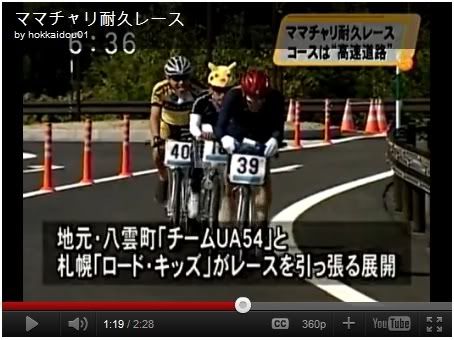
Pikachu Bicycle Helmet Cover!
Only in Japan, during a mamachari (mommy bicycle) relay race, will you see Pokemon cycling accessories:
Video here, via blog post from The Truth About Cars here.
Labels:
culture,
cycling,
heh,
helmety goodness
Thursday, August 25, 2011
Aw, Don't Be Like That...
Christian VandeVelde, reacting to coming in 2nd place behind Levi Leipheimer in the time trial at the USA Pro Cycling Challenge in Vail, by 0.58 seconds:
Sunday, August 07, 2011
Monday, July 25, 2011
Tour de Crashes
As I suffer through Tour de France withdrawals, I want to reflect on some of the reasons that made the 2011 Tour so crash-filled. Some may say it was the narrow roads chosen for the route in the first week, combined with the bad weather, and a nervous peloton with a full complement of 198 riders. While it is conventional wisdom to expect lots of crashes in the first week because the riders are full of energy and nerves, and they don't really calm down until after the first rest day, it seemed to me that many of the crashes happened away from places one expects these crashes. The minor crashes happened where they usually do, on turns, in the narrow streets of the small villages, and in the melee of the final sprints. But there were also crashes that caused major injuries and abandons on flat, wide, newly surfaced roads. What was happening there?
On Versus, Bob Roll and Todd Gogulski offered a new wrinkle on the nervous peloton explanation: that the recent Grand Tour pelotons don't have a lot of experience riding with each other. In years past, the pro peloton would see the same guys over and again at all the different races, because the teams just weren't as big as they are now. Directors did not have the luxury of choosing their 9-man Tour squad from 30 guys like they do these days, so back then, the pro riders could pick up on each others' habits and cues in negotiating movement within the bunch. Not so these days, where riders may not have even ridden together on the same squad. After Stage 10, which saw the crashing out of Vinokourov, Van den Broek, and Zabriskie, even before the incident with a media car that knocked over Flecha and Hoogerland, David Millar spoke of a reduction in "camaraderie and respect" within the peloton, and how it had become more "mercurial" in recent years. Riding in a Grand Tour takes more than strong legs and a big heart, but also experience in bike handling, judgment of road conditions, and awareness of the other riders. Perhaps some of the younger GC hopefuls and their domestiques are just not ready mentally for riding with 190 other guys. But still, some of these silly crashes caused a lot of broken bones and concussions, instead of the usual scrapes and bruises.
The crash that took out Janis Brajkovic, and dashed Robert Gesink's GC hopes with a badly bruised back, happened on a day with some brutal crosswinds, which usually push riders to use up the entire width of the road. On those edges, the cyclists will sometimes have to pop onto the shoulder and then get back onto the road as they jockey for position in the pack. But it seems to me that these newly surfaced roads neglected shoulder work, so that there were high lips or berms on both sides of the lane. Any rider knows that it is bad news to slide down a lip on such thin wheels, and it is almost impossible to keep the bike upright, especially if both tires wash out in the loose dirt. It was a similar crash that took out Bradley Wiggins and Chris Horner, even though they were on different sides of the road. So while an inexperienced peloton was the probable spark of these crashes, sliding out in the gutter while trying to avoid them caused the serious injuries in the domino effect. So, counterintuitively, the newly paved roads made racing conditions more dangerous.
It was this combination of unfamiliarity among the cyclists in the pro peloton with the neglected shoulder work on some of the flat roads in France that caused the injuries for the protected riders of the peloton. Normally, it just wouldn't happen that a protected GC hopeful would be riding on the side of the road, but Contador crashed numerous times while on the outside of the pack, instead of the middle. Brajkovic and Gesink got caught up on the side of the road, as well as Wiggins, Horner, even Levi Leipheimer. The final top 3, Evans and the Schleck brothers, were on teams with some of the most respected and experienced men in the peloton, so their positions in the bunch were always well negotiated: towards the front and in the middle. Some may call it luck that they were not involved in any major incidents, but when you have George Hincapie, Jens Voigt, Stuart O'Grady, or Fabian Cancellara growling at the other teams to get out of the way, I certainly wouldn't call that luck.
On Versus, Bob Roll and Todd Gogulski offered a new wrinkle on the nervous peloton explanation: that the recent Grand Tour pelotons don't have a lot of experience riding with each other. In years past, the pro peloton would see the same guys over and again at all the different races, because the teams just weren't as big as they are now. Directors did not have the luxury of choosing their 9-man Tour squad from 30 guys like they do these days, so back then, the pro riders could pick up on each others' habits and cues in negotiating movement within the bunch. Not so these days, where riders may not have even ridden together on the same squad. After Stage 10, which saw the crashing out of Vinokourov, Van den Broek, and Zabriskie, even before the incident with a media car that knocked over Flecha and Hoogerland, David Millar spoke of a reduction in "camaraderie and respect" within the peloton, and how it had become more "mercurial" in recent years. Riding in a Grand Tour takes more than strong legs and a big heart, but also experience in bike handling, judgment of road conditions, and awareness of the other riders. Perhaps some of the younger GC hopefuls and their domestiques are just not ready mentally for riding with 190 other guys. But still, some of these silly crashes caused a lot of broken bones and concussions, instead of the usual scrapes and bruises.
The crash that took out Janis Brajkovic, and dashed Robert Gesink's GC hopes with a badly bruised back, happened on a day with some brutal crosswinds, which usually push riders to use up the entire width of the road. On those edges, the cyclists will sometimes have to pop onto the shoulder and then get back onto the road as they jockey for position in the pack. But it seems to me that these newly surfaced roads neglected shoulder work, so that there were high lips or berms on both sides of the lane. Any rider knows that it is bad news to slide down a lip on such thin wheels, and it is almost impossible to keep the bike upright, especially if both tires wash out in the loose dirt. It was a similar crash that took out Bradley Wiggins and Chris Horner, even though they were on different sides of the road. So while an inexperienced peloton was the probable spark of these crashes, sliding out in the gutter while trying to avoid them caused the serious injuries in the domino effect. So, counterintuitively, the newly paved roads made racing conditions more dangerous.
It was this combination of unfamiliarity among the cyclists in the pro peloton with the neglected shoulder work on some of the flat roads in France that caused the injuries for the protected riders of the peloton. Normally, it just wouldn't happen that a protected GC hopeful would be riding on the side of the road, but Contador crashed numerous times while on the outside of the pack, instead of the middle. Brajkovic and Gesink got caught up on the side of the road, as well as Wiggins, Horner, even Levi Leipheimer. The final top 3, Evans and the Schleck brothers, were on teams with some of the most respected and experienced men in the peloton, so their positions in the bunch were always well negotiated: towards the front and in the middle. Some may call it luck that they were not involved in any major incidents, but when you have George Hincapie, Jens Voigt, Stuart O'Grady, or Fabian Cancellara growling at the other teams to get out of the way, I certainly wouldn't call that luck.
Labels:
Grand Tour,
pro cycling,
Tour de France
Subscribe to:
Posts (Atom)