I just thought of this today, as the media around Los Angeles melt down covering his burial. Jackson's autopsy is not yet complete because of the large number of toxicology tests yet to be performed, which means Jackson is missing something as he is laid to rest today: his brain. So, the weird connection I made was that Jackson played the Scarecrow in The Wiz, the R&B version of The Wizard of Oz, who was looking for a brain. I guess that didn't work out afterall. Hmm.
Tuesday, July 07, 2009

Tour Tidbit du Jour - 7/7/2009
The team time trial was back in the Tour de France, just in time to greet the last winner of the TTT, a Johan Bruyneel managed team with Lance Armstrong on it. Same result too, as Team Astana handily beat the second place Garmin-Slipstream by 18 seconds. Rules in the past limited the time damage over the field by designating time gaps based on a team's placement at the end of the day, ten seconds per placement starting at +20 to the first 15, and +5 for the remainders. The only teams who got their actual time were the eventual winners and any team finishing within 20 seconds of that winning time. So, if your team finished dead last, the most time your first five finishers would have lost would be about 3 minutes. Anyone not finishing in the bunch got their actual finishing time. The actual team times awarded were also based on any time gaps smaller than the ten second or 5 second increments, depending on how close one team's finishing time was to the team immediately above it in the rankings. This year, in keeping with the no time bonuses rule, your team time is what your fifth finisher gets today (dropped riders still got their actual finishing times). For the weaker teams, this was bad news, as the last place team, Skil-Shimano, finished 5'23" back of Astana. Also, overall contenders Cadel Evans and Denis Menchov will have to make some heroic efforts in the mountains to make up the 2'59" and 3'52" they've lost to Armstrong and the Astana boys.
Monday, July 06, 2009
Tour Tidbit du Jour - 7/6/2009
It seems like I'm talking about jerseys a lot during this first week of the Tour, so how about I write about why the jerseys have those colors. Why yellow, green, polka dot, and white? Well, the yellow jersey was given that color because L'Auto, the creator of the Tour, printed its editions on yellow paper. The green jersey, introduced in 1953, had its color chosen by the first sponsor of the sprint competition: a lawnmower manufacturer who chose green for grass. The KOM jersey had a similar history, as its first sponsor in 1975 was a chocolate company who wanted the jersey to match the packaging of a new product they were trying to sell.
The white jersey, for the young riders' competition, was originally awarded as the prize for the combined classification competition, which awarded points for how well a rider is placed in the general, points, and KOM classifications. The Tour does not have this competition anymore, but the Vuelta still does, which still awards a white jersey for it. In 1975, the white jersey was changed to honor the best young rider in the general classification.
Sunday, July 05, 2009
Tour Tidbit du Jour - 7/5/2009
Yesterday, I wrote a little bit about the different jerseys in the Tour, and who gets to wear them at the start of Stage 2. However, missing from the discussion was who gets to wear any of the jerseys on the first stage, or the prologue. Tradition at the Tour has been that last year's winner gets to wear the yellow jersey during the first stage. But yesterday, Carlos Sastre, who wore number 1 and started last at the time trial, both events subject to Sastre being last year's winner, wore his regular time trial kit. It seems it was just a little bit more disrespect heaped on to the unassuming Spaniard: the Tour organizers refused to let him wear yellow.
As the VeloNews article explains, the previous Tour winner wearing yellow on the following year's first day is only a tradition, not a rule. However, it has been a tradition for almost 40 years. That makes it almost a rule, but not really. Paraphrasing from the VeloNews story again, the "rule" has not been followed since Lance Armstrong retired after winning his 7th consecutive Tour in 2005. There was no returning champion in 2006, the real winner of 2006 had not been decided yet because of Floyd Landis' doping violation so Oscar Pereiro couldn't wear it, and Alberto Contador was excluded from the 2008 tour. So, the organizers decided to do away with the tradition. But here's your tidbit: the tour organizers agree with Lance Armstrong's feelings on the matter. When Lance began the 2003 Tour, beginning his quest to equal Miguel Indurain's 5 consecutive Tour victories, he refused to wear the yellow time trial kit in honor of the Tour's centenary, saying "I prefer the right to earn it." So, even though Lance is responsible for the missing yellow jersey in 2006, and doping scandals abducted it in the succeeding years, Lance actually threw a wrench in the works of the tradition a few years before then, not only in 2003, but beginning in 2000, when he returned to France defend his first Tour victory in 1999. In reality, 2009 marks the tenth year since a yellow jersey has been worn at the first stage individual time trial.
Saturday, July 04, 2009
Tour Tidbit du Jour - 7/4/2009
This year's Tour de France leads off with a time trial, but instead of a prologue, the race in Monaco serves as Stage 1. Fabian Cancellara, again, showed his absolute dominance in the Individual Time Trial, beating runner-up Alberto Contador by about 18 seconds. Contador leading Astana's big four over the 15.5 km course is a story in itself, besting Kloeden by 4 seconds, Leipheimer by 12 seconds, and Armstrong by 22 seconds.
Because Cancellara won the first stage, that means that he not only wears the overall leader's yellow jersey, but also the sprinters' green jersey for tomorrow's stage. Obviously, one man can't wear all those jerseys at once, so the second place rider in the overall gets to wear the green jersey. There's actually a hierarchy in the jerseys on who gets what, if the overall leader owns all of them at the same time, which can happen in the first week of the Tour: yellow, green, polka-dot (for the mountains leader), and white (for the best young rider under 26). What's funny about today's time trial, is that there was actually a categorized climb at the midway checkpoint, so whoever got there first is the King of the Mountains right now. At the checkpoint, Cancellara didn't even place in the top ten, well behind Contador, Columbia-HTC's Tony Martin, and Garmin-Slipstream's Bradley Wiggins. The jersey oweners after stage 1 are as follows: yellow and green - Fabian Cancellara; polka-dot - Alberto Contador; white - Roman Krueziger. Normally the green jersey would go to Contador to wear tomorrow, but since he was the outright winner of the KOM points, he has to wear that, so the green jersey goes to the third place finisher, Bradley Wiggins.
Thursday, June 18, 2009
Tour Tidbit du Whazzatnow?
No, the Tour de France has not started yet, but a piece of news just came over the wires:
PARIS, June 18 (Reuters) - Earpieces allowing riders to receive orders from team bosses during races will be banned on two stages of next month’s Tour de France.
“The management committee granted approval for earpieces to be banned on two stages,” the International Cycling Union governing body said in a statement on Thursday.
The earpieces will be barred on July 14 and July 17.
Yeah, that's the whole story. Now, some old diehards complain about race radio making stage races boring, especially after the first couple of stages and the general classification is beginning to shape up. Breakaways become common on longer stages, even large ones of more than 8 guys, and the peloton may lose interest in contesting the stage for the big boys who want those sprint points or mountain points. The common tactic with the team earpieces, is that once everyone in the breakaway has been figured out, and none of them are considered a threat to any of the leaders, the peloton lets up, and then doesn't get serious again until there are 50 km left or so. Kind of boring for two hours or more as the peloton pedals tranquilo. Here are links to the two stages where earpieces will be banned: Stage 10 and Stage 13. If you notice, both are about 200 km long but 10 is a flat stage and 13 is a mountain stage. Stage 10 looks boring as all get-out, which would definitely be a breakaway stage with the sprinter teams reeling in the escaped riders within the last 50 km. Stage 13 may have some fireworks with that Category 1 climb mixed in with all the 2's and 3's, but only in the sense of the King of the Mountain leader trying to get points, and the GC guys making sure nobody cracks or attacks on some of those climbs.
Without earpieces, the domestiques will be busy going back to the cars to consult with their managers about who's missing from the other teams in the peloton, and then sprinting back up to their teammates for any news and tactics. Heck, one of the big boys might even slip into a breakaway and escape before the peloton notices. I think what's likely to happen is that the peloton will cover every attack, and the breakaways won't happen in the first 20 km as they have been the last few years.
The mountain stage 13 will be a confusing day on the bike, as the riders will be paying extra attention to everyone else around them. Also, I don't see the recent tactic of sending the tempo boys up in a break, and then coming back to help their leader on the later climbs, being used at all.
Except for early breakaways on the flat stage, and mountain men coming back to the big boy group on the mountain stage, I really don't think these two stages will show us anything different or dramatic. But hey, the Tour always tries something different to pique cycling nuts' interest. This year, again, no time bonuses whatsoever, so the time trials will be important, especially the team time trial.
Personally, I love the radio communication between all the team members, and it's been fun to see how, as the equipment has been getting cheaper and more reliable, that they've been given to everyone. I remember when only the most successful teams (*cough* Postal *cough*) had one or two radios among all the riders, and worked maybe 60 percent of the time. Now everyone has them, and they work about 80 percent of the time. It's like watching NASCAR or IRL at a tenth of the speed!
Tuesday, June 02, 2009
Cycling Dude?
Um, I don't resemble this guy in the least..., well, maybe 75%.
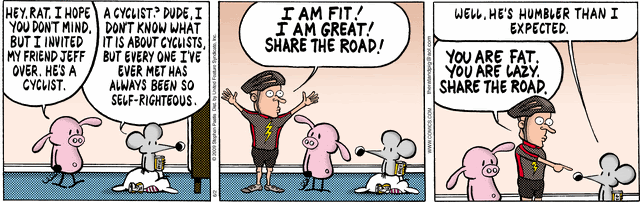
Update: Oh, yeah... SHARE THE ROAD!
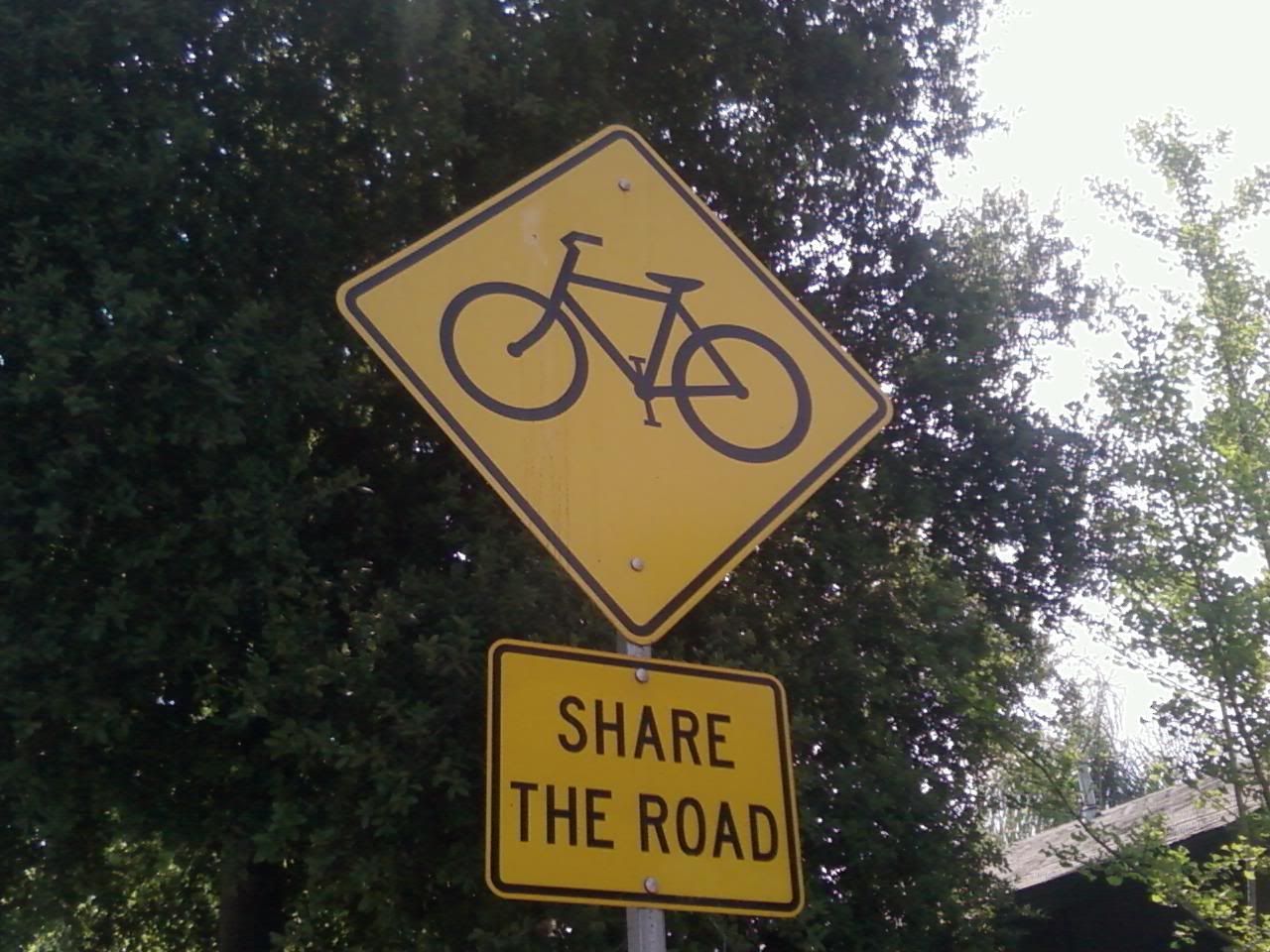
Photo taken during the morning ride.
Subscribe to:
Posts (Atom)